The nose plays a central role in facial balance, and even subtle differences in its shape or projection can significantly affect how the face reads as a whole. For patients who feel their nasal tip extends too far forward, creating an appearance that feels out of proportion with the rest of their features, rhinoplasty offers a precise and lasting solution. Understanding what an overprojected nasal tip is, what causes it, and how facial plastic surgery addresses it can help patients approach a consultation with clarity and realistic expectations.
At Becker Aesthetics & Plastic Surgery, our board-certified facial plastic surgeons evaluate each patient’s nasal structure individually, developing a surgical plan focused on proportion, balance, and natural-looking results across our Philadelphia and New Jersey locations.

Projection, Balance, and What You Should Know: A Quick Overview
Whether you’ve noticed your nasal tip appears prominent in profile or are simply researching your options, these five points provide a useful foundation before diving deeper.
- An overprojected nasal tip extends too far forward relative to the face, disrupting overall facial harmony.
- The condition is most often caused by excess cartilage, strong tip support structures, or genetic nasal anatomy.
- Rhinoplasty using nasal tip deprojection techniques is the most effective long-term treatment.
- Results are designed to be subtle and proportionate; the goal is balance, not a dramatic change.
- Surgeon experience is a critical factor in achieving precise, natural tip refinement.
What Is an Overprojected Nasal Tip?
An overprojected nasal tip is one that protrudes too far outward from the face in relation to other nasal and facial structures. When viewed in profile, the tip appears to extend beyond what would be considered a balanced nasal projection relative to the lips, chin, and midface. In more significant cases, this excessive protrusion can give the nose a long, prominent appearance, sometimes described colloquially as a Pinocchio nose, that draws attention away from the eyes and other features.
Nasal tip projection is typically assessed using standardized measurements that evaluate the relationship between the tip and the nasal base, lips, and overall facial proportions. When nasal tip projection measurements fall outside an accepted range, the tip may be considered overprojected. This is not purely a cosmetic judgment; it reflects a structural imbalance that experienced surgeons can evaluate and address with precision.
An overprojected nose may appear alongside other concerns, such as a drooping tip, a tension nose deformity, or changes in nasal length that compound the overall appearance. Understanding the full picture of what is contributing to the projection is an important part of surgical planning.
How to Tell If You Have an Overprojected Nasal Tip
The most common way patients recognize nasal tip overprojection is through profile photographs. When looking at the side view of the face, the tip appears to jut forward significantly, often past the lips or beyond what feels proportionate to the rest of the nose and face.
Some patients also notice that the nasal tip appears to dominate the face in frontal photos, making the nose look longer or more prominent than expected. Others become aware of the issue gradually, noticing that the appearance of their nose changes how they feel about profile images, or that it creates a sense of imbalance when looking at their face as a whole.
Common signs that may indicate an overprojected nasal tip include:
- A nasal tip that appears to protrude significantly beyond the lips in side-profile view
- A nose that looks long or dominant even when the bridge appears straight
- A tip that seems to pull attention away from other facial features
- A sense of nasal imbalance that is most apparent in photographs
- A nasal deformity sometimes described as a tension nose, where the tip appears tented or elongated
A formal evaluation by a facial plastic surgeon is the most reliable way to assess whether tip projection is a factor and what degree of correction may be appropriate.
Rhinoplasty Patient Results
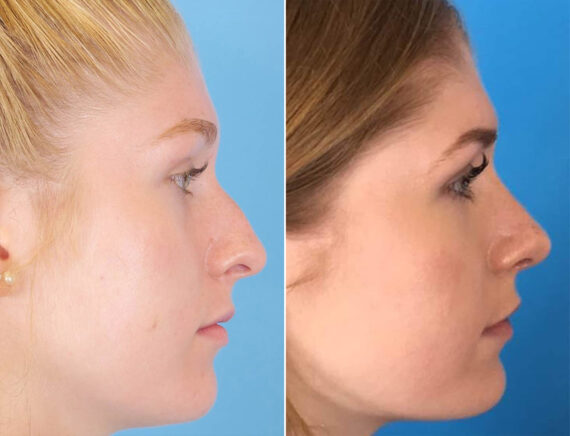
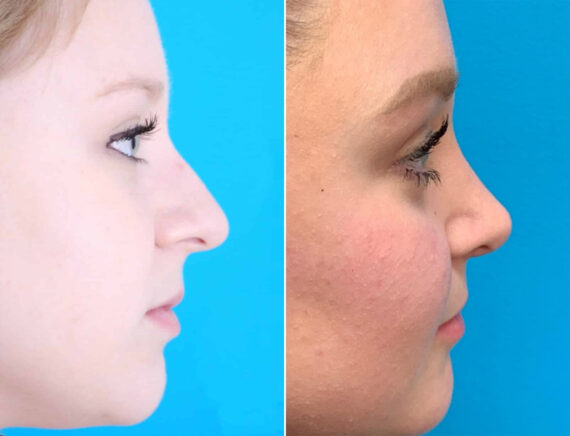
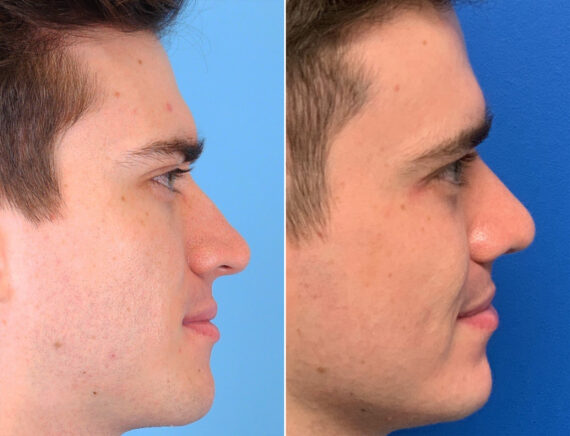
* All patients are unique and individual results may vary.
What Causes an Overprojected Nasal Tip?
Overprojection of the nasal tip is almost always related to underlying structural factors rather than a single isolated cause. Several anatomical contributors are commonly involved.
Genetics and Inherited Nasal Structure
For many patients, nasal tip projection is simply an inherited characteristic. Genetic nasal anatomy can predispose someone to a tip that projects more prominently relative to the rest of the face, regardless of whether any other nasal concern is present. This type of overprojection is often consistent across family members and tends to become more apparent as facial growth completes in the late teens.
Strong or Overdeveloped Tip Cartilage
The nasal tip is supported and shaped largely by the alar cartilage, a paired structure that determines how the tip projects and rotates. When this cartilage is particularly strong, long, or overdeveloped, it can push the tip forward beyond what facial proportions would support. Excess of cartilage in the lower lateral cartilages is one of the most common anatomical contributors to tip overprojection and is a primary target of deprojection techniques during rhinoplasty.
Nasal Structure Imbalance
In some cases, overprojection is not simply about the tip cartilage itself but about how nasal tip support interacts with the surrounding structures. A strong septal contribution to tip projection, an elongated columella, or the relationship between the nasal tip and the lateral cartilages can all influence how far forward the tip appears to extend. These structural dynamics require careful evaluation to ensure any surgical correction addresses the true underlying cause.
Previous Rhinoplasty
Patients who have had a prior nose surgery may develop tip overprojection as a secondary concern, particularly if earlier work altered nasal tip support in a way that shifted projection over time. Scar tissue, changes in cartilage position, or weakened structural elements from a previous procedure can all contribute. These cases typically require revision rhinoplasty and a higher level of surgical expertise to navigate safely.
How Rhinoplasty Corrects an Overprojected Nasal Tip
Nasal Tip Deprojection Techniques
Several nasal tip deprojection techniques may be used depending on the underlying anatomy and the degree of correction needed. Tip deprojection rhinoplasty often involves modifying the alar cartilage to reduce how far it pushes the tip forward. One commonly used approach is dome truncation, a technique that reshapes the dome of the alar cartilage to reduce projection while preserving tip definition and symmetry.
In cases where the nasal septum contributes significantly to tip projection, septal modification may also be incorporated into the surgical plan. Deprojection techniques are always planned conservatively. Overcorrection can affect both appearance and nasal function, which is why precision is essential throughout the procedure. The specific deprojection techniques selected depend entirely on the individual’s anatomy, the degree of protrusion, and the surgical goals established during consultation.

Choosing Between Open and Closed Rhinoplasty
The approach used to access the nasal structures, open or closed rhinoplasty, also plays a role in how tip deprojection is performed. Open rhinoplasty, which involves a small incision at the base of the nose, allows the surgeon direct visibility of the nasal tip cartilage and surrounding structures. This is often preferred for more complex tip work, including cases requiring significant deprojection or structural repositioning.
Closed rhinoplasty, performed entirely through incisions inside the nostrils, may be appropriate for patients with more straightforward anatomical concerns. The decision between approaches is made during the consultation based on the individual’s nasal structure, goals, and the complexity of the surgical procedures involved.
Get the right approach for your nose
Experience world-class treatment from our top-rated providers at Becker Aesthetics & Plastic Surgery in Philadelphia.
Why Surgeon Experience Matters in Tip Deprojection
Nasal tip refinement is widely considered one of the most technically demanding aspects of facial plastic surgery. The nasal tip is a three-dimensional structure, and even small changes to cartilage position or support can have a significant effect on both projection and overall nasal appearance. Overcorrection, asymmetry, or disruption of nasal tip support structures can all affect long-term outcomes, which is why choosing a surgeon with specific experience in tip deprojection is essential.
A qualified facial plastic surgeon with a strong foundation in nasal anatomy will evaluate not just the tip in isolation, but how it interacts with the nasal bridge, columella, nostrils, and the broader face. This comprehensive approach helps ensure that deprojection produces a result that looks natural from every angle, not just in profile.
At Becker Aesthetics & Plastic Surgery, our board-certified facial plastic surgeons bring extensive experience in both primary rhinoplasty and complex revision cases, with a track record of precise, balanced outcomes across diverse nasal structures.
What to Expect During a Rhinoplasty Consultation
A rhinoplasty consultation for an overprojected nasal tip typically begins with a thorough evaluation of nasal structure, facial proportions, and the patient’s specific concerns and goals. The surgeon will assess the degree of tip projection, the strength and shape of the underlying cartilage, skin characteristics, and how the tip relates to surrounding facial features.
Patients can expect a candid conversation about what rhinoplasty can realistically achieve, including the degree of deprojection that is appropriate given their anatomy. Surgical approach, recovery expectations, and any additional nasal concerns that might be addressed at the same time are also discussed during this visit.
Before-and-after photos of similar cases are often reviewed during the consultation to help align expectations and give patients a concrete sense of what natural, proportionate results look like. This is also the opportunity to ask questions, raise any concerns about the procedure, and confirm that the surgical plan feels right before moving forward.
Is an Overprojected Nasal Tip Affecting Your Confidence?
For many patients, concern about nasal tip projection is something they have lived with for years, aware of it in photographs, conscious of it in profile, but unsure whether surgery is the right step. Rhinoplasty for tip overprojection is one of the more focused and precise plastic surgery procedures available, and when planned carefully, it produces results that feel natural and proportionate rather than dramatically altered.
If you are considering rhinoplasty for an overprojected nasal tip in Philadelphia, Princeton, Voorhees, Sewell, or the surrounding New Jersey area, Becker Aesthetics & Plastic Surgery offers personalized consultations with board-certified facial plastic surgeons who specialize in nasal refinement. Contact one of our offices to schedule a consultation and take the first step toward a more balanced, confident appearance.
Frequently Asked Questions About Overprojected Nasal Tip