Labiaplasty is one of the most personal decisions a woman can make, and it is also one of the most commonly performed aesthetic genital plastic surgery procedures today. For many women, the motivation is physical — enlarged labia can cause discomfort during exercise, cycling, sexual activity, or simply wearing fitted clothing. For others, the goal is aesthetic, a desire for better symmetry or a more comfortable relationship with their own body. In many cases, both factors play a role.
What surprises many patients during the research phase is that labiaplasty is not a single procedure. Several surgical techniques exist, each with its own approach, advantages, and ideal candidates. Understanding the differences is an important part of making an informed decision — and finding the right plastic surgeon to guide that process matters just as much as the technique itself.
At Becker Aesthetics & Plastic Surgery, Dr. David W. Allison performs labiaplasty for patients throughout Philadelphia and New Jersey, offering individualized care and surgical planning tailored to each patient’s unique anatomy and goals.
The Techniques, the Tradeoffs, and What to Know First
Understanding the main labiaplasty techniques is the first step toward an informed decision.
- The trim technique and the wedge technique are the two primary surgical approaches to labiaplasty surgery, each addressing labial tissue in a different way.
- The trim procedure removes excess tissue along the outer edge of the inner labia, while the wedge procedure removes a V-shaped section from the center.
- Deepithelialization is a less commonly used alternative that preserves the outer labial edges while reducing volume from the inner surface.
- The right technique depends on anatomy, aesthetic goals, and surgeon recommendation — there is no universal best option.
- A thorough labiaplasty consultation is essential to determining which surgical approach is appropriate for each individual patient.

What Is Labiaplasty Surgery?
Labiaplasty is a cosmetic surgery procedure designed to reduce and reshape the labia minora — the inner folds of the vulva — and in some cases the labia majora, or outer labia. The goal is to alleviate physical discomfort and improve the appearance of the genitalia for women who feel that enlarged labia affect their daily comfort, confidence, or quality of life.
Women seek labiaplasty for a range of reasons. Labial hypertrophy, a condition in which one or both sides of the inner labia are larger than average, can cause physical discomfort from twisting and tugging during physical activity or intercourse. Asymmetrical labia are also a common concern, as is simple aesthetic preference. In many cases, patients have lived with these concerns for years before realizing that a safe, effective solution exists.
Labiaplasty is typically performed as an outpatient procedure under local anesthesia with sedation or general anesthesia, depending on the patient’s preference and the complexity of the correction. The procedure generally takes one to two hours, and most patients return home the same day.
The Main Labiaplasty Techniques
Labiaplasty techniques differ primarily in where tissue is removed and how the incision is placed. Each approach has distinct characteristics that make it better suited to certain patients.
The Trim Technique
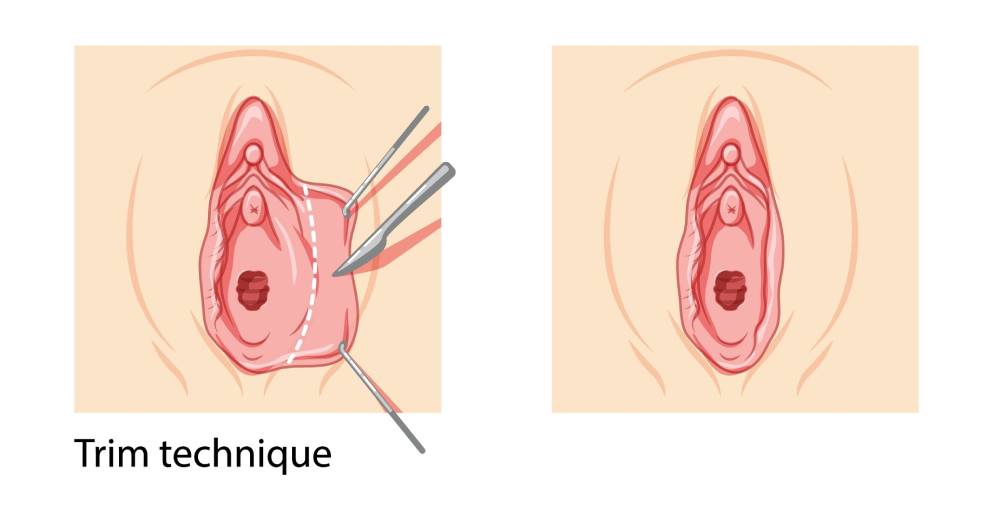
The trim technique — also called edge resection — is the most commonly performed labiaplasty approach. It involves making an incision along the outer edge of the inner labia and removing the excess skin that extends beyond the natural border of the outer labia. The labial edges are then closed with fine, absorbable sutures.
One of the primary advantages of the trim procedure is that it directly removes the outermost tissue of the labia minora, which tends to be the darkest and most irregular in texture. For women whose goal includes labia minora reduction alongside improved color and edge uniformity, this can be a meaningful benefit. The trim technique is also relatively straightforward from a surgical standpoint, and recovery tends to be somewhat more predictable.
The main consideration with the trim technique is that it does alter the natural outer border of the labia. Some women prefer to retain the original labial edges, in which case the wedge technique may be a better fit. Additionally, care must be taken around the area near the clitoris to ensure a smooth, natural transition where the two sides meet.
The Wedge Technique
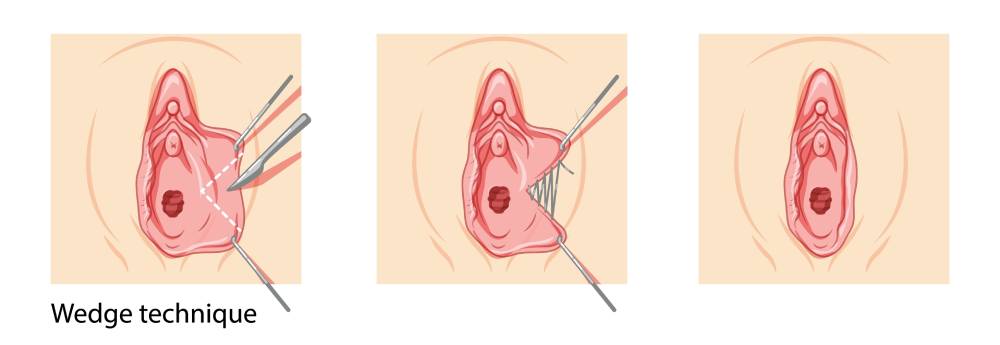
The wedge technique is the second most common surgical approach and has grown in popularity for its ability to preserve the natural contour of the labial edges. Rather than removing tissue along the outer border, this method removes a V-shaped wedge of tissue from the central portion of the labia. The remaining edges are then sutured together, reducing overall labial size while maintaining the original outer border.
Because the wedge procedure does not remove the outer edge of the labia, the natural color and texture of the labial edges remain largely intact. This makes the wedge method a preferred option for women who are primarily concerned with excess length or bulk rather than edge appearance. It also avoids incisions near the clitoral hood tissue, which some patients prefer.
The wedge technique is somewhat more technically complex than the trim approach, and healing requires closer attention — particularly for patients who smoke or take medications that affect circulation. Wound separation at the resection site is a known risk, which is why a thorough discussion of health history with your surgeon is an important part of choosing the right approach.

Deepithelialization
Deepithelialization is a less commonly used technique. Rather than removing tissue from the outer edge or center of the labia, this technique removes a layer of surface tissue from the inner face of the labia minora. A wedge or diamond-shaped area of tissue is removed from the interior surface, and the area is closed with sutures, reducing the overall projection of the labia while leaving the outer labial edges entirely intact.
The primary advantage of deepithelialization is that it preserves both the natural outer border and the natural color of the labia. Scarring is located on the inner surface only. However, the degree of reduction achievable with this technique is more limited than with the trim or wedge methods, making it most appropriate for patients seeking mild labia minora reduction rather than a more significant correction.
A Note on Laser-Assisted Labiaplasty
Laser-assisted labiaplasty refers to the use of laser technology in place of a traditional scalpel during the surgical procedure. It can be applied within either the trim or wedge approach and is not a separate technique in its own right. Some surgeons use laser tools for their precision and ability to reduce bleeding at the incision site. Availability varies by practice, and the choice of instrument is ultimately one factor among many in surgical planning.
Labiaplasty and Related Procedures
Labiaplasty surgery is sometimes performed alongside other related procedures when anatomy or patient goals call for a more comprehensive approach.
Clitoral hood reduction addresses excess folds of skin around the clitoris and is frequently combined with labiaplasty, particularly the trim technique, to create a more balanced and proportionate result across the entire vulva. Labia majoraplasty reduces or reshapes the outer labia, which may be a concern for some women independent of or alongside labia minora reduction. These procedures can often be performed in a single surgical session, reducing overall recovery time while addressing multiple concerns at once.
How to Choose the Right Labiaplasty Technique
Choosing between labiaplasty techniques is not a decision patients need to make on their own — that is exactly what the consultation process is for. That said, understanding a few key factors can help women come to that conversation better prepared.
Personal goals matter significantly. Women who are bothered by darker or irregular labial edges may find the trim technique better addresses their concerns, while those who want to preserve the natural border of the labia may prefer the wedge method. The degree of reduction desired also plays a role — more significant corrections are typically better suited to the trim or wedge approach than to deepithelialization.
Anatomy is equally important. Unique anatomy, skin characteristics, and the degree of asymmetry all influence which surgical approach is appropriate. A surgeon with experience across multiple labiaplasty techniques is better positioned to make an individualized recommendation than one who relies on a single method for all patients.
Recovery considerations are also relevant. The trim procedure generally supports a slightly more straightforward recovery, while the wedge procedure involves a deeper incision and may take a little longer to heal fully. Patients with health factors that affect healing — such as smoking — should discuss these openly with their surgeon.
Risks and Complications to Understand Before Surgery
Labiaplasty is a safe and well-established cosmetic surgery procedure with a high patient satisfaction rate when performed by an experienced, board-certified plastic surgeon. As with any surgery, however, risks and complications exist and should be understood before proceeding.
The most common complication is over-resection — removing more tissue than is appropriate for the patient’s anatomy. This can result in chronic dryness, discomfort at or near the vaginal opening, and pain during sexual activity. Choosing a surgeon who takes a conservative, anatomy-guided approach significantly reduces this risk. Other potential complications include bleeding, infection, asymmetry, changes in sensation, and wound healing difficulties. Complications are uncommon when the procedure is performed in an accredited facility with proper pre- and post-operative care.
Patients who smoke are at higher risk for healing complications with any surgical technique and are generally advised to stop smoking well in advance of surgery.
Recovery and Post-Operative Care
Most patients find labiaplasty recovery manageable with appropriate preparation and post-operative care. Swelling, tenderness, and mild discomfort are expected during the first week and can be helped by icing — alternating twenty minutes on and twenty minutes off — with a cold pack cushioned between undergarments and a light compression layer. Keeping the area elevated when resting also helps reduce swelling.
Most women return to desk work or light daily activity within about a week. Tampons and sexual activity should be avoided for four to six weeks, and exercise or any activity that creates friction in the area should be held off for the same period. Trim labiaplasty tends to allow for a somewhat quicker recovery, though individual healing varies.
Optimal healing depends on following your surgeon’s post-operative care instructions carefully. Loose clothing, gentle hygiene, and any prescribed ointments or medications all play a role in how smoothly the recovery process unfolds. Final results continue to refine as residual swelling resolves — while the most significant swelling subsides within six weeks, complete healing may take up to six months.
Your Labiaplasty Consultation at Becker Aesthetics & Plastic Surgery
The labiaplasty consultation is where anatomy, goals, and surgical options come together into a personalized plan. At Becker Aesthetics & Plastic Surgery, Dr. David W. Allison takes time during each consultation to evaluate the patient’s anatomy, discuss her concerns and expectations, and explain which surgical techniques are most appropriate for her specific situation.
Patients considering labiaplasty in the Philadelphia or New Jersey area are encouraged to schedule a private consultation with Dr. Allison to explore their options in a comfortable, discreet, and supportive environment. Whether the motivation is physical discomfort, aesthetic goals, or both, the right surgical approach begins with an honest, informed conversation. Contact one of our offices to get started.
Frequently Asked Questions About Labiaplasty Techniques