A crooked nose is one of the most common cosmetic concerns people bring up during consultations. For some, it is something they have always been aware of. For others, it developed after an injury or became more noticeable over time. Either way, the question is often the same: Is surgery really the only option? For the right candidate, the answer is no.
Nonsurgical rhinoplasty, sometimes called liquid rhinoplasty or a liquid nose job, offers a way to address mild nasal asymmetry using dermal fillers, without incisions, general anesthesia, or a lengthy recovery. At Becker Aesthetics & Plastic Surgery in Philadelphia, PA, board-certified facial plastic surgeons offer both nonsurgical and surgical options, so every patient gets a recommendation based on their actual anatomy and goals rather than a one-size-fits-all approach.

What You Should Know Before You Decide
- Liquid rhinoplasty uses injectable dermal fillers to make a crooked nose appear straighter without surgery.
- It is best suited for mild to moderate asymmetry, not structural or breathing-related concerns.
- Results are temporary but can last many months and can be maintained with follow-up treatments.
- A board-certified facial plastic surgeon should always perform nasal filler injections due to the complexity of nasal anatomy.
- Surgical rhinoplasty remains the better option when significant crookedness, a deviated septum, or breathing issues are involved.
What Actually Causes a Crooked Nose?
Before exploring nonsurgical options, it helps to understand why noses appear crooked in the first place. The nose sits at the center of the face, which means even a slight deviation draws more attention than it might elsewhere. Crookedness can originate from a number of different sources, and identifying the cause matters when choosing the right treatment path.
Some of the most common causes include:
- A deviated septum, where the wall of cartilage dividing the nasal passages leans to one side
- Nasal bones that healed unevenly after a broken nose or facial injury
- Natural asymmetry in the bone and cartilage framework that becomes more pronounced with age
- Previous nose surgery that left minor irregularities along the bridge or nasal tip
- Uneven skin thickness or soft tissue distribution across the nose
When the underlying cause is structural, meaning it involves the nasal bones, septum, or cartilage framework, surgical rhinoplasty is typically the more appropriate solution. However, when the nose appears crooked primarily because of surface-level irregularities or subtle asymmetries in soft tissue, a nonsurgical approach may produce a meaningful visual improvement without any invasive procedure.
Can a Crooked Nose Be Addressed Without Plastic Surgery?
The short answer is yes, in some cases. Nonsurgical rhinoplasty works by placing small amounts of filler in precise locations along the nose to create the visual impression of straighter, more symmetrical contours. The procedure does not actually move bone or cartilage. Instead, it fills in depressions, smooths transitions, and creates a more balanced profile through careful volume placement.
This approach works particularly well for patients who have a slight deviation along the nasal bridge, a minor dip or irregularity that makes one side look lower than the other, or residual asymmetry following a previous rhinoplasty that does not require revision surgery. If you are self-conscious about how your nose looks in photos or from certain angles, but your breathing is fine and the overall deviation is mild, liquid rhinoplasty may be worth discussing with a facial plastic surgeon.
It is equally important to be clear about what nonsurgical rhinoplasty cannot do. It cannot make the nose smaller. It cannot narrow wide nostrils. It cannot address breathing difficulties caused by a deviated septum or collapsed nasal valves. And it cannot replicate the degree of change that surgical rhinoplasty can achieve. Managing expectations from the start is a key part of any honest consultation.
Liquid Rhinoplasty Patient Results
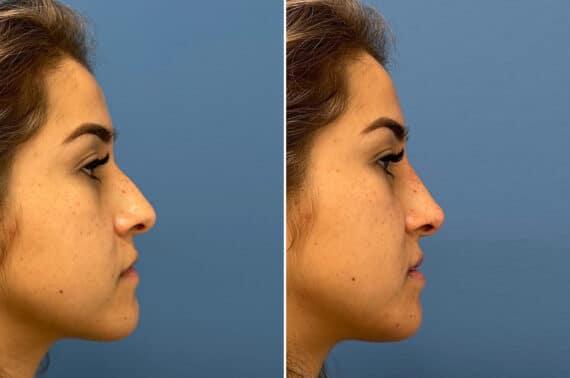
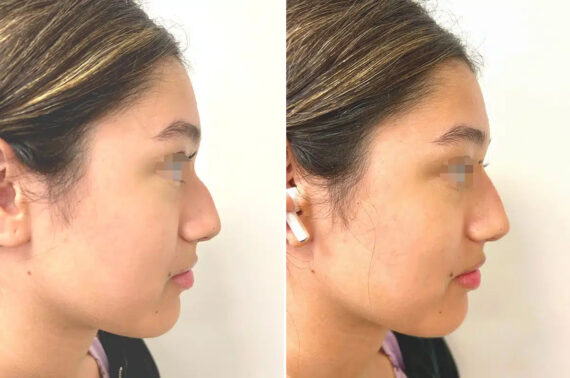
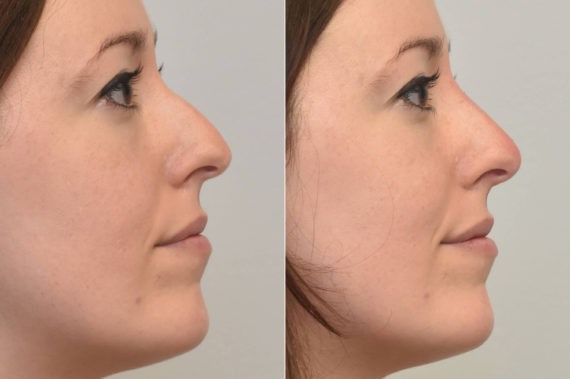
* All patients are unique and individual results may vary.
What Is Liquid Rhinoplasty?
Liquid rhinoplasty, also called a liquid nose job or nonsurgical nose job, is a cosmetic procedure that uses injectable fillers to reshape the appearance of the nose without surgery. At Becker Aesthetics & Plastic Surgery, hyaluronic acid fillers are commonly used for this purpose. Hyaluronic acid is a substance that occurs naturally in the body, and when used as a filler, it can be layered, shaped, and — importantly — dissolved if needed. That reversibility makes it a particularly good choice for nasal filler treatments, where precision matters and small adjustments can have a noticeable effect.
During the procedure, the surgeon evaluates the nose from multiple angles and identifies where targeted volume placement will create the most meaningful visual improvement. For a nose that appears crooked due to a small dip on one side of the bridge, adding filler to that area can create a smoother, straighter profile. A subtle amount of filler placed at or just above the nasal tip can also improve definition and symmetry without altering the underlying cartilage at all.
The entire appointment is typically completed in under thirty minutes once a treatment plan is established. Most patients experience only mild pressure during the injections, as hyaluronic acid fillers generally contain a local anesthetic. There are no incisions, no bandages, and no splints. Results are visible immediately.
How Fillers Address the Appearance of a Crooked Nose
Understanding how liquid rhinoplasty works in practice can help you decide whether it aligns with your goals. The technique relies on the visual principle that smooth, even surfaces appear straighter than uneven ones. When one side of the nasal bridge dips lower than the other, filling in that low point creates a more consistent line across the bridge. The nose has not physically moved, but the eye perceives a straighter shape.
Specific ways that fillers can improve the appearance of nasal crookedness include:
- Smoothing irregularities along the nasal bridge so the profile looks more even
- Filling small depressions that cause one side of the nose to look lower or more indented
- Improving nasal tip symmetry by adding subtle definition on one side
- Creating a more balanced facial profile overall, when combined with other nonsurgical treatments like chin filler
The surgeon’s skill and anatomical knowledge are what make the difference between a natural-looking result and one that looks overdone. The nose is a highly vascular area with complex anatomy, which is why nasal filler injections carry more risk than fillers placed in other parts of the face. This is not a treatment to seek from a general injector or medical spa without confirmed expertise in facial plastic surgery and nasal anatomy specifically.
Who Makes a Good Candidate for Nonsurgical Nose Correction?
Nonsurgical rhinoplasty is not the right answer for every patient with a crooked nose. Good candidates tend to share a few common characteristics. They have mild to moderate nasal asymmetry that is cosmetic in nature, meaning it affects appearance more than function. They are not experiencing breathing problems, nasal obstruction, or chronic congestion that suggests a structural issue. They understand that results are temporary and will require maintenance, and they have realistic expectations about the degree of change that fillers can produce.
Patients who may not be ideal candidates for a nonsurgical approach include those with significant skeletal deviation of the nasal bones, a deviated septum that causes breathing difficulties, a history of prior filler in the nose from another provider, or cosmetic goals that go beyond what filler placement can realistically achieve. For these patients, surgical rhinoplasty or, in cases involving breathing concerns, septorhinoplasty is the more appropriate path.

At Becker Aesthetics & Plastic Surgery, the surgeons who perform liquid rhinoplasty also perform traditional rhinoplasty and revision rhinoplasty. That breadth of experience means they can give honest guidance about which approach actually makes sense, rather than defaulting to the nonsurgical option simply because it is more accessible.
Get the right approach for your nose
Experience world-class treatment from our top-rated providers at Becker Aesthetics & Plastic Surgery in Philadelphia.
How Long Do Nonsurgical Rhinoplasty Results Last?
Results vary depending on the individual, the type of filler used, the amount placed, and how the body metabolizes the product over time. In general, most patients enjoy the outcome for many months, with some maintaining their results for close to a year or longer. When the effect begins to soften, a follow-up appointment can restore the original shape.
It is worth noting that because the nose involves areas of high movement and vascular activity, filler may not last quite as long there as it does in less dynamic areas of the face. Your surgeon will set realistic expectations during your consultation so you know what to plan for going forward.
When Surgical Rhinoplasty Is the Better Option
Liquid rhinoplasty is a genuinely useful tool, but it has clear limitations. If your crooked nose stems from a deviated septum, fractured nasal bones, or significant skeletal asymmetry, fillers can only mask the surface; they cannot address the underlying structure. In these situations, traditional rhinoplasty or septorhinoplasty offers a permanent, structural solution.
Surgical rhinoplasty allows the surgeon to reposition nasal bones, reshape or reinforce cartilage, straighten the septum, and create lasting improvements that nonsurgical treatment simply cannot replicate. For patients dealing with breathing difficulties alongside cosmetic concerns, surgery may also address functional issues at the same time, improving both how the nose looks and how it works.
The surgeons at Becker Aesthetics & Plastic Surgery are experienced in both approaches and will always guide you toward the option that is genuinely in your best interest. If surgery is appropriate, they will explain why. If nonsurgical rhinoplasty can accomplish what you are looking for, they will tell you that too.
Schedule a Consultation for Crooked Nose Treatment in Philadelphia
If you have been wondering how to address a crooked nose without surgery, a personalized consultation at Becker Aesthetics & Plastic Surgery is the best place to start. Patients from Philadelphia, South Jersey, Princeton, Voorhees, and surrounding communities are welcome to meet with our team to discuss liquid rhinoplasty, surgical rhinoplasty, or a combination approach tailored to their specific anatomy and goals. Contact our Philadelphia office today to schedule your appointment and take the first step toward a nose that feels more balanced and like you.
Frequently Asked Questions About Nonsurgical Crooked Nose Treatment