Patients understandably want a clear picture of what open rhinoplasty recovery involves before they schedule surgery. They wonder how long they will look bruised, when they can get back to work and to the gym, and when their nose will finally look the way they pictured. Those are smart things to ask, because knowing what is ahead takes a lot of the worry out of the experience.
I am Dr. Daniel Becker, a double board-certified facial plastic surgeon at Becker Aesthetics & Plastic Surgery, where I specialize in rhinoplasty and revision rhinoplasty. I have guided a great many patients through this process, and the truth is that healing is steady and predictable for most people. Below is the recovery timeline most patients can expect, along with tips to help you heal well and protect your final results.
Your Open Rhinoplasty Healing Process, From Splint to Final Results
Here is the short version before we get into the week-by-week detail.
- Most of the visible swelling and bruising fades within the first two to three weeks.
- You will wear a splint for less than a week, and that short time is the most restrictive part of recovery.
- Your nose keeps changing in small ways for months, and the final results can take up to a year to fully settle.
- Rest, cold compresses, and keeping your head elevated all support the early healing process.
- Call your surgeon right away if you notice heavy bleeding, signs of infection, or anything that feels wrong.
What to Expect After Open Rhinoplasty
Open rhinoplasty is the technique where I make a small incision across the columella, the strip of skin between the nostrils, so I can fully access and reshape the structures of the nose. In my practice, recovery tends to follow a consistent, predictable arc, and understanding it ahead of time makes the whole thing far less stressful.
The procedure is done on an outpatient basis, so you head home the same day with a splint protecting the nose. In the first stretch, expect some swelling and bruising, a stuffy and congested feeling much like a head cold, and a nose that does not yet resemble the new shape you are working toward. All of that is completely normal. A nose reveals its result slowly, so patience really is part of the job.
Open Rhinoplasty Recovery Timeline
Everyone heals at their own pace, so treat what follows as a map rather than a stopwatch. Still, most of my patients move through these stages in a similar order.

The First Few Days
The first 72 hours are the most intense stretch. Swelling and bruising around the eyes and nose build and tend to peak around day two or three, and you will feel stuffed up because the lining inside the nose is swollen. Most discomfort in this window is mild and feels more like pressure and congestion than sharp pain. Rest is the main job right now, along with keeping your head elevated, even while you sleep.
The First Few Days

Week 1 After Open Rhinoplasty
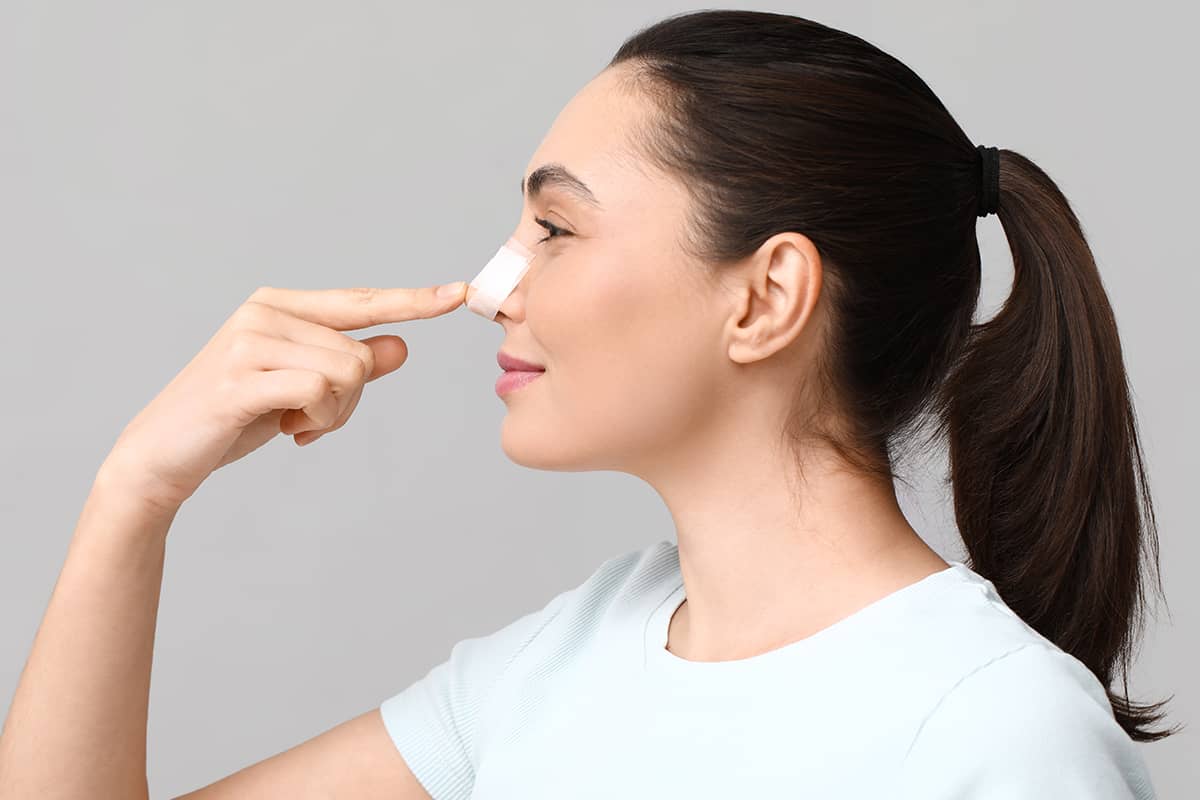
By the end of the first week- and usually after just a few days – the splint comes off, which tends to be a real morale boost. Your nose will still be swollen and may look slightly upturned or wide at this point, but seeing it free of the splint is encouraging. The bruising starts shifting from purple toward yellow and fading, and the congestion eases as your nasal passages open back up. Many people feel well enough to move comfortably around the home by now, even if they are not quite ready to be seen everywhere.
Week 1
Weeks 2 to 4
Through the second week and the rest of the first month, the obvious signs of surgery quiet down. This is a bit faster in younger patients and a bit slower in older patients, as you might expect. The bulk of the dramatic swelling and bruising is gone by about two weeks, which is why so many patients plan around that point before stepping back into a normal social life. By weeks three and four, you will look like yourself again to most people, even though a subtle puffiness lingers that really only you and I are likely to spot. This is usually when light activity resumes, though I still ask patients to hold off on anything strenuous.
Weeks 2 to 4
Months 1 to 3
Across the first month into the third, healing shifts from obvious to subtle. The swelling that remains sits mostly in the nasal tip, which is always the last area to settle. Your nose is quietly refining the whole time, with small day-to-day changes adding up in your favor. More vigorous exercise and most normal routines come back during this window, once I have cleared you for them.
Months 1 to 3

6 Months to One Year
From six months to one year after surgery, the finishing touches come into focus. The last of the deep swelling resolves, the nasal tip sharpens, and the nose settles into its final results. For most patients, full recovery and the true result arrive somewhere around the one-year mark. If revision rhinoplasty is ever a consideration, I generally do not even evaluate it until the nose has finished healing at this stage.
6 Months to One Year
Get the right approach for your nose
Experience world-class treatment from our top-rated providers at Becker Aesthetics & Plastic Surgery in Philadelphia.
How to Support the Best Results During Recovery
A good outcome is not only about what happens in the operating room. What you do while you heal has a real effect on how smoothly recovery goes and how your nose looks in the end. These are the recovery tips I give every patient.
- Sleep propped up on a couple of pillows for the first week or two to help limit swelling.
- Take it easy early on, and avoid bending over or heavy lifting, which raise pressure in the nose.
- Use cold compresses around the eyes and cheeks in the first 72 hours, never directly on the nose.
- Stay out of direct sun and use sun protection, since healing skin is more vulnerable to sun damage.
- Resist blowing your nose, and be gentle with the area while the incisions settle.
- Hold off on strenuous exercise until I clear you, which is usually a few weeks in.
- Eat well, stay hydrated, and avoid smoking, which slows the healing process considerably.
When to Call Your Rhinoplasty Surgeon
Most open rhinoplasty recovery is smooth and uneventful, but you should always know when to reach out. Contact your surgeon, or seek care, if you have heavy or persistent bleeding, a fever, growing redness, warmth, or discharge around the incisions, severe pain that your medication is not controlling, or any sudden change that alarms you. New or worsening trouble breathing is also worth a call. I would always rather hear from a patient and put their mind at ease than have them sit at home worrying, so please never hesitate to check in.
Plan Your Open Rhinoplasty in Philadelphia or New Jersey
If you are thinking about open rhinoplasty, the clearest next step is a one-on-one consultation where we can talk through your goals and what recovery would realistically look like for you. My team and I care for patients across Philadelphia, Princeton, Voorhees, Sewell, and the surrounding New Jersey area. When you feel ready, reach out to the office most convenient for you to schedule a consultation.
Frequently Asked Questions About Open Rhinoplasty Recovery